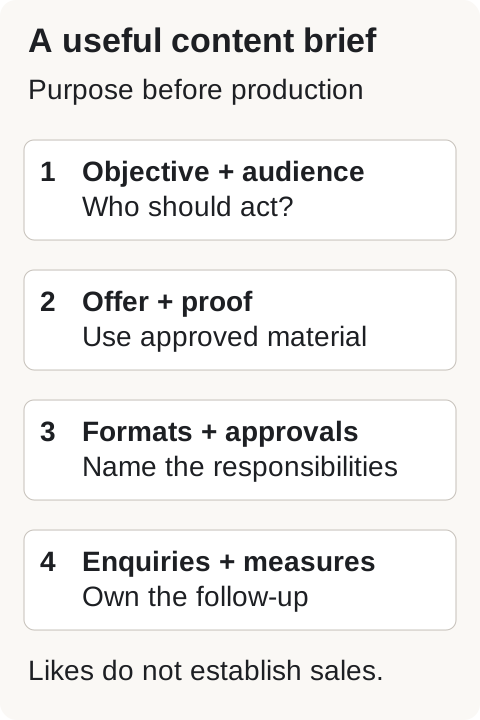

“We need more posts” is a production request. A useful social media brief explains what those posts should help the business do, which customers they should reach and how interest becomes a conversation.
For a Qatar business, the brief also needs accurate service areas, language choices, approval responsibilities and a plan for enquiries. Write these down before comparing proposals based on the number of posts.
Start with one business objective
Choose the immediate priority: introducing a service, explaining a complex offer, supporting an opening or helping customers understand why they should enquire. Name the service and desired action.
An illustrative B2B training provider might want enquiries from HR managers about a specific workplace programme. That is a clearer brief than “grow our Instagram”. It does not assume Instagram is the right platform; the audience and buying process should inform that decision.
Define how you will judge progress using evidence available to you. Relevant enquiries, conversations with suitable prospects and service-page visits can be useful. Likes can describe response to a post but cannot establish revenue on their own.
Describe the audience and buying questions
Explain who makes the decision, where they are based and what they need to understand. Separate the person who uses the service from the person who approves it when those roles differ.
List questions your team hears repeatedly: what is included, which customers the service suits, what happens first and what information is needed for a quote. Note whether your audience is in Qatar only or includes other GCC markets. Do not treat the GCC as one interchangeable audience.
Specify the approved language for the work. Translation, adaptation and additional language review need an agreed scope and approver; they should not be assumed from a target location.
Supply the offer and proof
Provide the current service description, differentiators you can support and any genuine limits. Include the approved website link and contact route. If a promotion is proposed, identify who approves its terms before it appears in content.
Gather brand files, approved photographs, product information and customer material you have permission to use. Record what each asset shows and whether names, faces or business details can be published. Do not present stock imagery as completed work or fill gaps with invented testimonials.
Agree content themes and formats
Build a small set of useful themes around the objective:
- Explain the service and who it suits.
- Answer a customer question or clarify a buying decision.
- Show genuine work or an approved process.
- Explain the next step and information needed to enquire.
Choose formats that suit the material and team capacity. A service explanation may work as a short video, a simple graphic or a written post; a format should have a purpose. Separate ongoing content from a one-time campaign, and organic work from paid distribution and its separate spend.
Name the people and the handoffs
Record who supplies information, approves copy, attends filming and authorises publication. Agree how feedback is consolidated and what happens when material or approval is late. Confirm who controls account access without placing passwords in the brief.
Assign someone to handle comments and direct messages. Define which questions they can answer, when to escalate and where qualified enquiries are recorded. Content can generate interest while the business still loses it through unclear follow-up.
Use a brief that a supplier can act on
Your final brief should contain the objective, audience, service, evidence, themes, platforms under consideration, language, production inputs, approver, enquiry owner and measures. Include the actual budget boundary and ask for a scoped proposal; avoid an open-ended promise to fund every recommended channel.
Beyond Line connects content to the business offer and follow-up process. Explore Beyond Social, our social media management service and discuss your content requirements. Bring your service priorities and existing material so the first discussion can establish what to produce and why.